When I first started my genealogy journey back in the mid to late 1990s I made a conscious effort at the time not to work on my maternal grandmother’s paternal line. My great grandpa had left the family. Why would I care who his ancestors were?
But things changed in my thinking after my mom died in 2011. I began to do more than just find birth, marriage, and death records. Finding stories about family made them more real. The story of my great grandparents was far more complicated than just that great grandpa left.
My great great grandfather was John Ray Mohney. He was the son of Adam Mohney and Amanda Moyer. One thing I learned about the family is Adam died when John was only 3 years old. His mother remarried. When he was 18 he married Jennie Shingledecker, my great grandmother.
John made some pretty bad choices in his life. I won’t go into all of those. He definitely hurt people. But when I found out what likely instigated the final ending of the marriage it all started to make sense.
Kalamazoo Gazette, Sun, Jun 6, 1926, page 2.
I am hoping it was a choice by all adults involved to have the relationship that they did. But when the poverty that they were living in with all of those children was found out, that must have been some sort of sign for my great grandmother to tell him to move on. Of course that is just a guess on my part. No matter how it went down it started to all make sense. It is no wonder he left. He was not providing enough for such a large family. The stigma for whatever their relationship was would have been too great.
No matter what went down between those adults, it is all starting to make more sense and my thinking about him and doing his family research has definitely changed. There isn’t much more left to find out about him besides hoping his other family has some pictures somewhere. Besides that, my focus on that line has been to learn about his ancestors. Because he may have chosen the second wife, that doesn’t mean the people who made him aren’t worth researching.
In family history research it is common to come across conflicting information about an ancestor. This information can come from family members sharing stories or from the actual records we find. Here are some steps to take to resolve those conflicting pieces of information. These steps are especially for an ancestor that you’ve done as detailed as possible of a search for records.
Start out with knowing what specifically you are wanting to find once you resolve the conflict. Is there conflicting information on the birth date of an ancestor? Knowing specifically what your research question is will help you better look at the sources you have already gathered. When did John Mohney, husband of Jennie Shingledecker and father of Beatrice Mohney, die?
Gather all the information on this ancestor that is conflicting. I recommend if you haven’t created research notes on this ancestor, this could be a good time to start. These notes should be in chronological order. They will help show any conflicting information. You can of course start those later and just write notes on the conflicting information. A spreadsheet could be a way to visualize the conflicting information if working at the computer is helpful in your research.
Next, look at where each piece of information came from. The simplest way to look at this is to ask whether the person who gave the information on the record was an eye witness to the event. While there may be errors even from eye witnesses (like a family member of the deceased filling out the death record and giving the wrong information for parents), looking at all the evidence you have and where it came from will help you know whether you can trust that the information in a piece of evidence is correct or not, in many cases. An obituary (unless written in advance by the deceased) while helpful is often not written by someone who was an eyewitness to the person’s whole life. Evaluating the records can give you clues on whether you can fully trust a source.
You’ve evaluated each piece of evidence to see if you’ve found a source that was from an eye witness. Is a source you are looking at an index or an actual scan of the original document? You’re also looking at things like ages, names (spellings, etc), and locations and making sure they are similar to other facts that you have. If your ancestor only lived in Michigan and you find a marriage record in South Dakota, it is highly likely that the South Dakota record is not your ancestor unless other records give evidence of your ancestor being in South Dakota around that time.
My research question in the second paragraph above, “When did John Mohney, husband of Jennie Shingledecker and father of Beatrice Mohney, die?” This was a research question I had about my maternal grandmother’s father. The family didn’t know when he died. Census records noted my great grandmother as widowed. Marriage records for some of my great aunts said that their father was dead. These records showed a picture that my great grandfather died after the 1920 Census and before the 1930 Census. But based on family rumors about there being a second wife I was able to find his death record. He had not died in the 1920s. He had died in 1945 in Minnesota. So it ended up that he was dead to my great grandmother and their kids back in Michigan, but he went on living with his second wife and their children in Minnesota.
In many cases you will be able to figure out which piece of information is the correct one. Other times you’ll get a close to the answer. But there will be times where you won’t be able to resolve the conflicting information and you won’t be able to confirm the information you are looking for. This process will at least help you evaluate your sources and figure out other areas where you could search that you may have overlooked.
I try not to share too personal of things on this blog, but instead of getting stuck in a circle of indecision on what to write about, I will write about the first story to come to mind. This is actually from my own family. It involves two individuals in my family. One is my mom and the other happens to be my paternal grandpa.
My parents were married in September 1974. They had gotten together earlier that year and my mom was already pregnant with my sister, Letecha (pronounced Letitia). Letecha was born on July 3 of that year. 13 days before my parents wedding, Letecha died. My mom was devasted of course. My parents began their married life together and tried for another baby. Sadly, my second sister, that they named Jennifer was born stillborn in July of 1975. Another great loss for my mom.
Not long after losing Jennifer my mom decided to not try again and went on birth control. I guess my grandpa had a talk with my mom about it. Said things like he knew she was sad after losing her babies, but that he knew she would make a good mother and that she wanted a child. She told me he took her birth control pills and threw them away.
Obviously my mom could have just pulled them from the trash when he left the house. But she didn’t. She decided to open her heart to the possibility of a baby and she finally got a baby the following Fall. Followed by another two years later. Both of those babies made it to adulthood.
Life was not easy after those babies were born, but she definitely made a big decision. To trust that her love and determination would bring those babies to life and to adulthood.
This prompt made me think of one of the projects I am doing for someone. On a census record one of their ancestors is noted as step son and notes a different surname to all the other records for this son. Subsequent generations use the family name this son’s father had, but if it wasn’t for this one census record the family might not even know that he was not his father’s biological son.
Not long after that census year the father left the mother. Likely oldest son being noted as his step son was likely a sign that the relationship was collapsing. It makes me wonder if the son knew that his father wasn’t his biological father.
I’m reminded of a census record from my own family tree. My 2x great grandfather, William Henderson, is listed as the adopted son of his mother’s husband. Same as her second born. But the previous census the children both had the surname of Littler. What changed between those two records. Did William and George grow distant from their mother’s husband? Was there some sort of rift? Or maybe these two boys still had contact with their biological father’s families and they felt a connection to their possibly deceased fathers and wanted to honor them by keeping the surnames they had a birth.
The one son from the first story could have known his father wasn’t his biological father, but since he knew him since he was a small boy he was all the father he knew so kept that name. And with my own ancestor and his brother, they may have had a good relationship with their step father. They are noted as adopted sons and not step sons after all. It is hard to know exactly what transpired with these two families. They all saw each other as family, no matter what the blood relation was or not. Family is often bigger than blood in the end.
This is a favorite picture of my family. There are girls standing in an archway between rooms. Very period dressed for the mid to late 1950s. The tallest girl is my aunt Connie. The two girls closest to her are two of my other aunts, and the blonde at the end is likely a cousin.
It is the two figures seated that draw me most into this picture. The woman is my grandmother, Beatrice. And the little girl is my mother, Jennie. I never got to meet my grandma, so when my mom got this picture about 20 years ago it was so neat to see my grandma in such a candid pose. And of course to see my mom as a tiny little girl was pretty neat, too, as there weren’t many pictures of her in early childhood before her mom died. This is only the second picture I’ve seen of her as a small child.
I look at this picture and wonder who my mom and grandma were looking at. Who was just off to the right making grandma smile. Was it my grandpa behind the camera? So many questions. No answers to these questions, but it is nice to see a snapshot of my family well before I was born.
As I looked through all the research I have done to find something that encompasses the prompt of a breakthrough moment an idea popped into my mind. I realize this prompt is more for things like breaking through a brick wall or finding out something hugely important in telling an ancestors story, but I am doing to look at it from a different perspective.
I think a breakthrough moment I have had in all the research that I have done is that family history research shouldn’t be focused on finding big stories. While it is always interesting to find something that tells you a lot about your ancestor, sometimes it is the little things that really brings these people to life. Professions, clubs, small newspaper stories/ads, or even a photograph that you haven’t seen before. Your ancestor may not have done something overly newsworthy, but there are pieces of them still there in the records for you to find.
One tip is to look for your ancestor in newspapers. Sometimes you can find them in little things like a letter waiting for them at the post office. Or an announcement for a club meeting. Another thing to find in the paper would be sale of land between two people. You can also find out about visits your ancestor made to other people outside of their town or city. Or if they receive a visitor from out of town. Those extra names can be use for FANs (Friends, Associates, and Neighbors) research to possibly broaden the story.
Another tip is to look through any directories for the area that your ancestor lived. Often the directory showed a little bit about what your ancestor did for a living. And for your women ancestors the directory often told if they were a widow of a certain man and will list his name. Some directories even note who died since the last director was made.
There tends to be a rush to get back as far as possible in your research. Go slowly. Look in several different places. Think outside the box on where you can find family history. A trip back to where your ancestors lived may be in the works, but you would be surprised what can be found online now. Like over at Archive.org has a lot of local papers that might not be available locally.
Coming at family history from a place of seeing a fuller picture of your ancestor will make the search far more fulfilling than hoping to find some famous ancestor or to reach back to Europe or elsewhere. Some people can’t even get back to the original home land through the historic records. Learning about each generation beyond birth, marriage, children, and death is so important to having a well rounded picture of the ancestors and to have a more fulfilling connection to the past.
I was trying to find something to talk about from my volunteer work or client work related to “A Theory in Progress” but the thing that popped in my head first was my maternal 3x great grandma Susan Huff. I talk a lot about my mother’s line and Susan has always been the last mother I can name as I have not confirmed her mother or father. We had a few clues on where she and Richard lived before moving to Ohio, but nothing concrete.
Susan’s death record had her father as Joseph Huff, but nothing else connected her to her father. I knew she was from Pennsylvania so I looked up Joseph Huff in the census. I was able to find one that lined up more than the others. He lived with his wife Hannah and likely 9 children. There are three daughters who would have been of age of marriage around the time Susan married Richard. The issue is none of them are named Susan. The possible names are Angeline, Emeline, and Catharine. There is a Catharine who had married a Fisher in the county, so that is likely not Susan, but there are records that mix of Catherine and Angeline as marrying the same Fisher, so that adds some confusion. It seems most likely that Emeline is Susan, but that is just a guess.
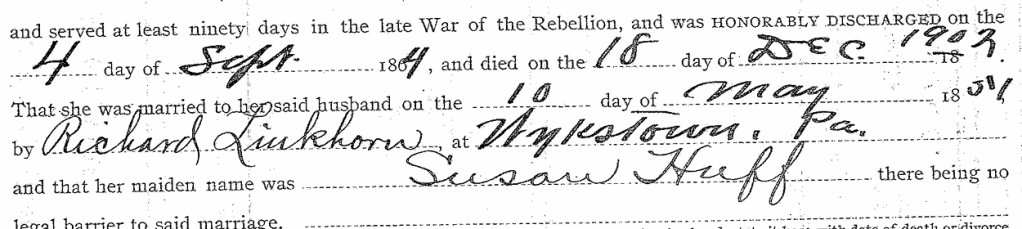
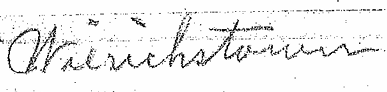
Susan Huff married Richard Tea on May 10, 1852. We did not know this date or the general location until I ordered Richard’s Civil War records and the pension records. In another spot in the pension it states they were married May 10, 1851 by Richard Linkhorn at Wykstown, PA. The issue with this information is there are no records of a Richard Linkhorn in newspapers or in census records. And to add to the issue, there is no place called Wykstown.
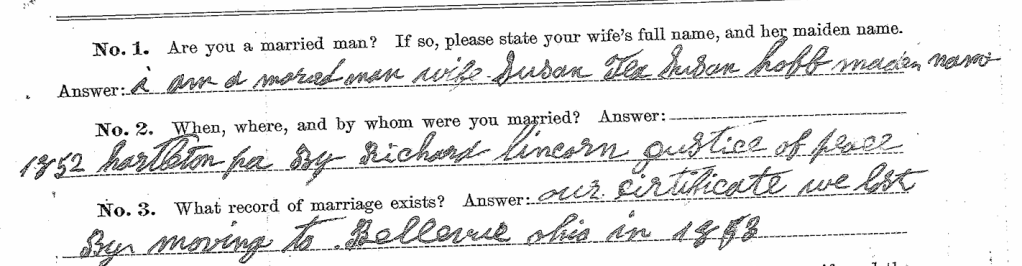
Another section notes they were married in 1852 in Hartleton, PA by justice of the peace, Richard Lincorn. Hartleton is a borough in Union County, PA. This county coincides with the Joseph Huff that is believed to be Susan’s father. On this record it is noted that the family moved to Ohio in 1853 and in the move they lost the marriage record.
In a statement from Susan’s sister Sarah, it notes that Susan and Richard were married in at the home of Eliza Manbeck’s family in a place that was called Centreville in 1904, but went by another name when they married.
I am still trying to figure out this name and if it was even called that for long. But from what we do know, the marriage did take place in Union County. I found online that Centreville was southwest of Penns Creek in Union County, PA. Near Jack’s Mountain.
Update. While in the middle of writing up this blog post I was doing a page by page review of the 1850 Census record there in Hartley Township (which is where Centreville was in). I ran across someone by the name of Richard Lincoln. I went to Newspapers dot com and looked up Richard Lincoln and Justice of the Peace. And there he is listed as the Justice of the Peace for Hartley for 1851. So we know that his name was not Richard Lincorn or Richard Linkhorn. It was Richard Lincoln. Which kind of makes more sense. It should be noted that a man named Joseph Hartley was a witness to the wedding. He happened to be living with Richard Lincoln in 1850.
Susan may be Emeline from Joseph and Hanna/Joanna Huff’s family. If she wasn’t, she may have been living with other family members at the time of the 1850 Census. There is a chance that she was living with an uncle in Hartley Township in 1850. There is a Susan Huff living with Daniel and Sarah Huff. This reason this is a possibility is mostly because the ages of the children in the house are not in order from oldest to youngest. While Susan was supposed to have been slightly older than this girl, there is still a chance it is her. Regardless of whether this is our Susan in the home of Daniel and Sarah, they are likely her aunt and uncle (or some other relation) so if Emeline is our Susan, then there are many reasons she would be married near aunt and uncle instead of at her parents house.
In the pension record Susan is mentioned as being married at the home of the parents of Eliza Manbeck. Eliza is likely a relation to Susan as her maiden name was likely Huff. So possibly she is a daughter of Daniel and Sarah Huff. There is a chance Eliza is listed more than once in the 1850 Census living with two separate families (maybe even a third location which is not far from the other two) and thus why she wasn’t at home with her parents before her marriage. If Susan Huff got married at the home of Eliza Manbeck’s parents, then they were likely Daniel and Sarah Huff, her likely aunt and uncle.
Until we find a record for Susan and Richard marrying, or find some other evidence of Susan actually being Emeline (or one of the other daughters), we cannot fully confirm that we have her parents. It is still highly probable that Emeline is her and the Susan Huff in Hartley Township is her. I will likely need to contact the archives and other repositories in the area to see if any marriage records with the Justice of the Peace still survive.
With this prompt I will be talking about the story, as we know it now, of how Lincoln Memorial Park Cemetery in Carson, California was formed. This post isn’t about a specific ancestor, but it was what popped in my head first when I saw this prompt.
I am working with Aisha Woods, the founder of the Margie L Woods Foundation, to build the history of Lincoln Memorial Park Cemetery. We have seen evidence in newspaper clippings about who was connected to the cemetery in the early days. Names like J.W. Poulson, who was noted as owning the land at some point before 1930 (likely even earlier); Robert Calver R.C. Mason – a realtor; Pierre Ellis Myers, a realtor who worked closely with the community to build the cemetery for the local people especially. There are also names like Irene Givens, who was one of the first African American women to run a cemetery.
A lot of the history in the newspapers related to the cemetery early days have been scant. I was able to narrow down some search queries on Newspapers.com and finally find the first results related to those who wanted to start the cemetery. The locals and the county Board of Supervisors had at first rejected the permit for the cemetery. We still haven’t found out how they eventually got it approved. There is a chance that the reason it got approved is because the realtors appealed to the community. We know that Pierre E Myers went to many churches and attending many events to build up interest in the cemetery.
The final details about who had owned the land and who organized to bring the cemetery to reality have not been fully discovered. But from the details we have so far, it seems like it took a community wide effort. Pierre E. Myers practically going door to door. Attending events and ensuring that this endeavor would be community focused. It became the communities cemetery, not just some a long term investment for the original planners.
Regardless of whether the original developers had altruistic beliefs about forming this cemetery or not, what the story of Lincoln shows me that it takes the community to make something happen. One individual cannot make something a reality. Especially when it comes to something that benefits the whole community. The leaders in the community came together and backed the cemetery and members in the community trusted that the investment they made for their and their family’s resting place. It was the community that made Lincoln a reality.
Lincoln has gone through a lot over the years with several scandals. The most recent scandal was the owner of the cemetery abandoning it in 2023. And just like community members at the founding coming together to found the cemetery, it has taken community members like Aisha Woods, Valerie Holyfield, Felicia Jones, and so many others to come together and bring the cemetery back to life. It takes community to bring important things to life, or back to life in the case of Lincoln.
Continuing on with 52 Ancestors in 52 Weeks (though I think I’m just going to call this 52 prompts at this point. lol ), and the second is ‘A Record That Adds Color”. Again I am going to share some research I’ve done for other projects instead of my own ancestors. This post is on a man who went by a few different names over the years, which adds to why I chose to write about him. He was definitely a colorful person.
Lucius Lehman was born March 10, 1863, likely in Jamaica (or the West Indies as it was called in those days). His birth location is based on several earlier records connected to him, including his naturalization records. His arrival date to the United States was supposedly sometime around 1886. His Declaration of Intention to become a US Citizen was filed in 1899 notes his country of birth and his arrival date of October 1886. The only issue with this date is he was in Los Angeles in December of 1886 when he married Ann Smith. While he could have quickly left New York City and gone to Los Angeles, it is more likely he arrived sometime before the Fall of 1886. The 1910 Census gives his arrival date at 1880 and the 1920 Census gives it as 1882.
Lucius made some bad choices over the years. Attempted murder, assault of a child, theft, murder. So my writing a blog post about him is not to extol him as some great person. I am just telling a story about a life that was very colorful. The first records of him were related to attempted murder of his wife and assault of his step daughter. He was sentence to 12 or 14 years in a state prison, but was released after about nine years, for good behavior.
Lucius married Mattie Clark in December 1897. About 6 months later he was arrested for stealing two bags containing valuable papers from James Robinson. Robinson put an ad in the paper offering a reward. Lucius returned some of the papers to a lawyer who brought them to the newspaper and requested the reward. The police were called and Lucius was told to find the rest. He said he found the items in some ravines adjoining Westlake Park. After helping the police for a few weeks in finding items, the police arrested him.
He was brought before Judge Owens and represented himself in the case. He cross examined witnesses at great length. The newspaper articles note this: “Lenan is not a full-blood negro. he says his grandfather was an Englishman, and that he was educated for diplomatic service in London. He professes to speak thirteen languages proficiently and is a master of several systems of shorthand reporting, besides a system of his own invention. He is 37 years old, and served several years in the British navy on the Camperdown and other first-class warships prior to coming to Los Angeles.”3 It was found during this case that his marriage to his first wife was not finalized by legal divorce, so a bigamy charge was laid upon him.
More details in the newspaper articles around this case show him saying he was in the country “in obedience to a commission received from the Cuban insurgent authorities, and that proper inquiries at the offices of the Cuban junta in New York City will establish his identity”4. It is said in another article that he worked under General Garcia in Cuba and was wounded at the battle of El Caney.
The bigamy case was thrown out, likely because the first wife had filed for divorce, but did not have the funds to complete the divorce. And in the case against him for burglary, he was acquitted, mostly for lack of evidence that he actually stole the items.
Mattie and Lucius had a bit of a rocky marriage, but while they were still together they had two daughters. Anita was born in 1899 and Marion was born in 1903. In 1903 Lucius became a citizen of the United States.
Lucius was living in Riverside County by 1910. And it was there that he got into an argument with Theodore Lashley in Winchester. The argument ended in Lucius shotting Theodore. Theodore died the following day. Lucius was charged with murder and was convicted of the crime. He was sentenced to life in prison. He would be sent to San Quinten up in Marin county, which is on the bay just above San Francisco.
While in prison Lucius would become the prison store clerk. He also would later be considered a sort of mullah (teacher) for the religion of Islam and had influenced many people to accept the faith while in prison. There are no records that show he practiced the religion, but with the number of stories told and the research of people like Dr Patrick D Bowen, he made an impact on many people during his time at San Quinten. And Dr Bowen shows evidence that his impact even reached the one day founder of the Nation of Islam, Elijah Muhammad, who is said to have done time at the prison.
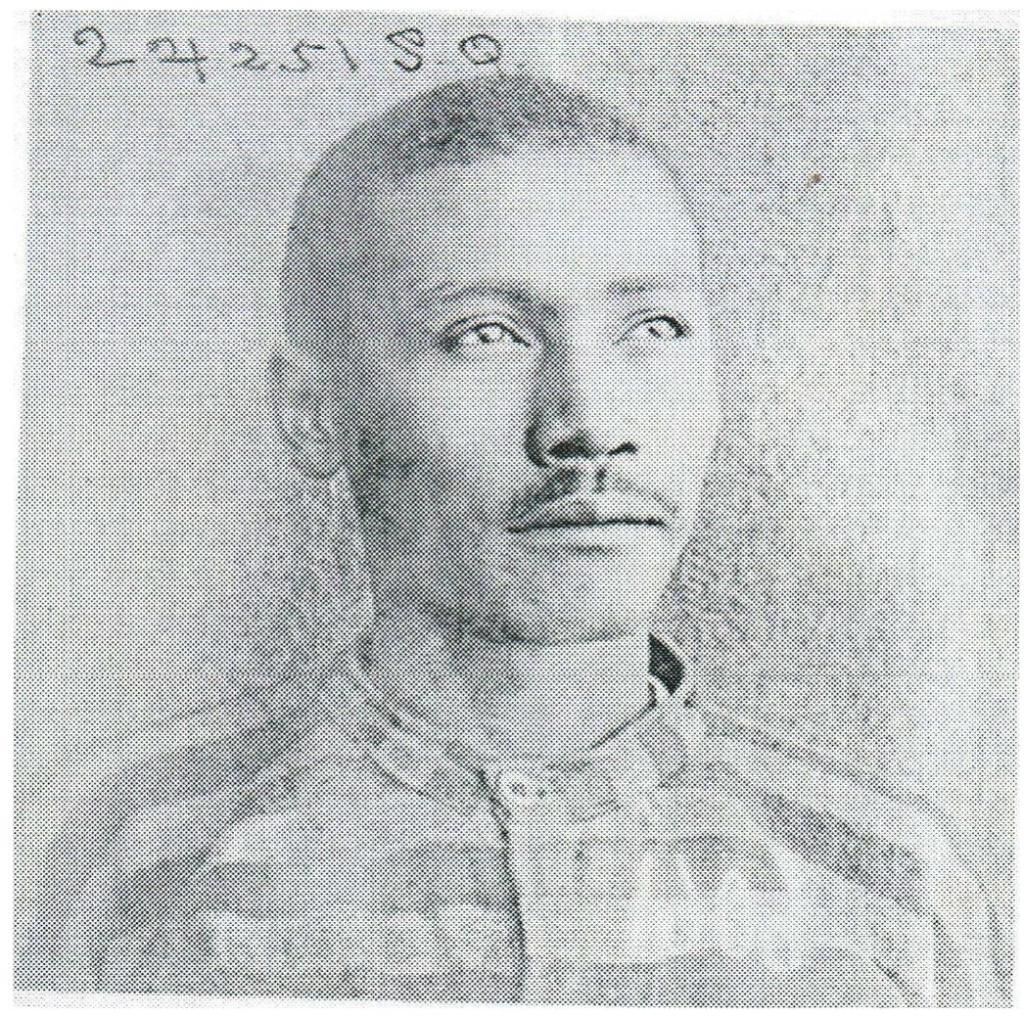
Lucius did not spend the rest of his life in prison. He was paroled on August 7, 1924. I have not found him in the 1930 Census, possibly he had only just gotten back to Los Angeles County by the time of the 1930 Census. He died on February 11, 1937. Interestingly, he was at the National Military Home in Los Angeles when he died. How and why he ended up there is a mystery and likely will require digging through any existing records from the National Military Home. His birth place is noted as Kartoon, South Africa. But possibly it was meant to be Khartoum, which is a city in modern day Sudan, as there is no city similar to that name in South Africa. Even till the end this man was a mystery. He was buried at Lincoln Memorial Park Cemetery in Carson, California.
Something interesting to note about his children. His daughter Marion married actor Edgar Hughes “Blue” Washington. Their son Kenny Washington went on to be the first African American to sign with the National Football League in the modern era.
I’ve decided to do Amy Johnson Crow’s 52 Ancestors in 52 Weeks challenge. A lot of prompts this year seem to bring to mind things that come to mind from the research I have done. And seeing as I mostly do research on other people’s ancestors I plan to focus most of my posts on other people’s ancestors.
Aberdeen Butler was a man who was born about 1820-1825 in Georgia. His mother’s name was Amy. He had at least two siblings, Prince, and Venus. The family was enslaved in Florida by several families both in Georgia and Florida, largely by William B Nuttall (1802-1836) and his wife Mary Savage’s second husband George Noble Jones (1811-1876). But enough about them.
The Butler family lived on El Destino Plantation in Jefferson County, Florida. It is/was southeast Capitola, Florida, near the end of the Hall Branch stream, which is likely a branch of the Saint Marks River basin (the main house was located at about this location 30.432300814492574, -84.06455189709206).
Aberdeen worked in the mill on the plantation. We know this because of the extensive plantation records that George Nobel Jones kept. These records are on FamilySearch and on the Florida Memory website run by the archives of the state of Florida In this record we see a moment in Aberdeen’s life that makes me admire him.
A few women on the plantation had left and were found in Tallahassee. One of those women was Venus, Aberdeen’s sister. It is not fully clear from the records exactly why the women left, but it was likely because of abuse from the overseer. The overseer had found the women and when they were brought back to the plantation he said he went to put them in the plantation prison. And that’s when he said Aberdeen took an axe and was going to go after him, but a driver named Prince stopped him. The overseer and a neighbor both wrote to Jones telling him their side of things. Aberdeen was not seriously punished for this. The reason we know this is because he went on to live till the 1910s.
Aberdeen married Martha Evans had several children. They were: Whatley 1851, Mina 1852, Mary 1853, Ben 1858, Daphne 1860, Stephen 1862, and Venus 1864. While Aberdeen never, that we know of, owned his own home, he worked hard on the farm he rented and raised all of his children to adulthood. His wife Martha died some time between 1880 and before the 1900 Census date. Aberdeen lived a long life. He likely died between 1910 and before the 1920 Census. He would have been close to 90 years old when he died.
His life was filled with hardship. He even risked his life to try to protect his family. He survived and his family thrived even among the circumstances that the post Reconstruction South brought. I admire him because regardless of his circumstances he was willing to risk it all to save a loved one. May we all have that courage in the face of whatever is placed against us in this world.
Research Notes: You can find all research notes on Aberdeen here at his WikiTree profile. Special thanks to those who improved the bio and added sources. https://www.wikitree.com/wiki/Butler-25971




You must be logged in to post a comment.