While doing some work on the One Place Study I am doing for the neighborhood I grew up in I decided to start looking for when the first non European person moved into the neighborhood. From that I decided to start compiling census records and city directory entries that note a person who is not European. I’m making them available here so that others may be able to find their ancestors easier. So far I have found Black Americans, Chinese Americans, and at least one Native American.
I will be updating this continually. If you happen to find someone not listed on my sheets who should be there, please let me know.
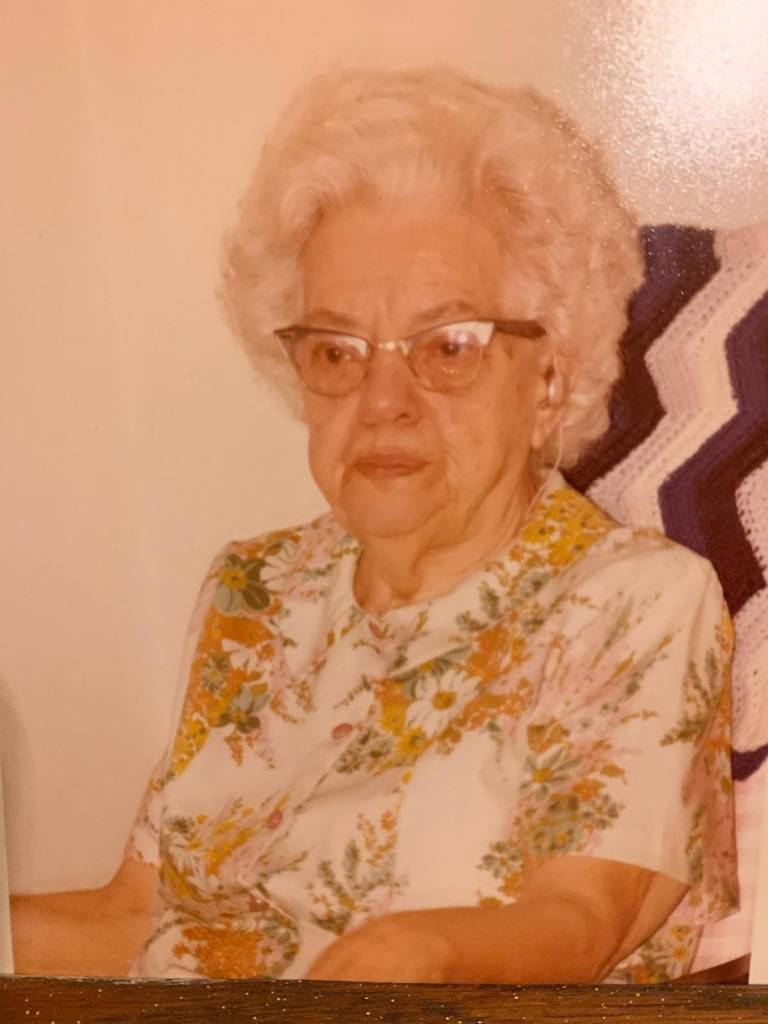
I’ll be following the 52 Ancestors in 52 Weeks prompts this year from Amy Johnson Crow’s website (Find the description and how to sign up to get the prompts HERE). The first prompt is Fresh Start. I’ve chosen my great grandmother Jennie (Shingledecker) Mohney to write about for fresh start.
Jennie was born in 1890 in Schoolcraft, Michigan. Her parents were William and Nettie Mae Shingledecker. She was the 2nd child of four. She married John Ray Mohney when she was 18 years old. They had their first child before the end of that year. By the 1920 Census the family had moved to South Dakota and included 4 more children. Jennie was still in South Dakota during the South Dakota state census of 1925 and she had 3 more children by that date.
Things were not going great in the family as her husband had taken on a mistress. He had two children with the woman while still living with Jennie. Things must have come to light sometime in 1925 or early 1926 because Jennie was back in Michigan with the birth of her youngest daughter, Beatrice (my grandmother).
From her son Carl’s obituary I found out that John Ray actually moved the family back to Michigan, but then ended up leaving the family (to go back to his mistress). It must have been difficult to lose her husband that way. One way that she made it work was to tell people that her husband had died. All records I’ve found so far show Jennie as a widow. These include census records from 1930 and 1940 as well as marriage records for her children.
Jennie wasn’t alone in handling this fresh start. Her older children definitely helped out. Not only did she have her oldest daughters to help out, it seems she fostered a spirit of working hard in her children. In her son Carl’s obituary it notes that he taught his children “”The Mohney Way”: value hard work and do things right the first time.” I imagine that was more something he learned from his mother, Jennie, as she was the one who raised Carl alone for most of his childhood. While I get calling it the Mohney Way because his last name was Mohney, but I would have called it the Shingledecker Way, as his mom was the one who taught him hard work and sticking with those who matter most.
I don’t know much about her life overall, but I know Jennie was a hard worker. She raised 9 children who all grew to be hard working adults. She spent her later years with her children’s families, including visiting her daughter May’s family home in Charlevoix, Michigan.
Jennie (Shingledecker) Mohney was a hard working woman who raised 9 children. I am grateful for her determination to care for her children even through the heartache of losing her husband the way she did. I’m glad my grandmother had such a strong woman role model in her life because she ended up making a good impression on my mother who made a good impression on me. I am forever grateful for her. She truly made the most of her fresh start away from her husband.
I’ve been to two naturalization ceremonies and at each one the new citizens take the oath of allegiance. All the new citizens stand and repeat the oath after the presiding judge. It is an uplifting experience. Interesting fact, the first citizens of the United States (free men to be specific) were required to take an oath of allegiance as well.
I found that one of my ancestors (Richard Tea) was appointed as a commissioner to administer the oath/affirmation of allegiance. There seem to be different versions of the oath that I’ve found. And I believe each state had their own version of the oath, though they would all have been similar. The Wikipedia article on the current oath of allegiance says that parts of it were based on the British Oath of Supremacy, written in the 16th century (though the article does not cite a source on this statement).
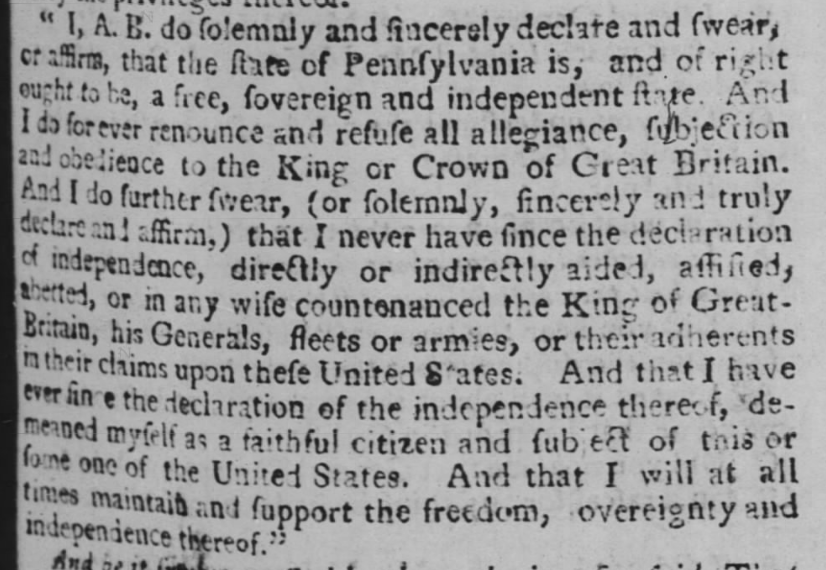
There were several versions of the oath. There was even one that officers in the Continental Army took. Here is one form of the oath as printed in The Pennsylvania Packet (Philadelphia, Pennsylvania) from Tuesday February 2, 1779.
I’ve tried to find Richard Tea’s name in the many lists of those who took the oath of allegiance, but possibly there’s a reason he’s not included in it. If he name is listed as someone who could administer the oath, he had to have taken the oath.
“I don’t think you can ever leave home.
You take it with you. It’s in your hair follicles,
in the bend of your knees, the arch of your foot.
You can’t leave home. You just take it and rearrange it”
– Maya Angelou, African-American Lives (PBS), 2007
Welcome to my family history blog. Come join me as I learn more about both sides of my family. The four most recent family names are Jousma, Clark, Julien, and Mohney. I will be sharing personal data on my ancestors as well as information on the places they lived and events that they may have lived through.
Beecher Family
Bensinger Family
Clark Family
Clawson Family
Coffey Family
Henderson Family Jouwsma/Jousma Family – Fryslan (Friesland) Netherlands
Julien Family
Moerland Family – Zeeland, Netherlands
Mohney Family
Moyer Family
Neele Family – Zeeland, Netherlands
Robinson Family
Shingledecker Family – Southwest Germany
Tea Family

 On Their Shoulders
You must be logged in to post a comment.