
I was trying to find something to talk about from my volunteer work or client work related to “A Theory in Progress” but the thing that popped in my head first was my maternal 3x great grandma Susan Huff. I talk a lot about my mother’s line and Susan has always been the last mother I can name as I have not confirmed her mother or father. We had a few clues on where she and Richard lived before moving to Ohio, but nothing concrete.
Susan’s death record had her father as Joseph Huff, but nothing else connected her to her father. I knew she was from Pennsylvania so I looked up Joseph Huff in the census. I was able to find one that lined up more than the others. He lived with his wife Hannah and likely 9 children. There are three daughters who would have been of age of marriage around the time Susan married Richard. The issue is none of them are named Susan. The possible names are Angeline, Emeline, and Catharine. There is a Catharine who had married a Fisher in the county, so that is likely not Susan, but there are records that mix of Catherine and Angeline as marrying the same Fisher, so that adds some confusion. It seems most likely that Emeline is Susan, but that is just a guess.
Susan Huff married Richard Tea on May 10, 1852. We did not know this date or the general location until I ordered Richard’s Civil War records and the pension records. In another spot in the pension it states they were married May 10, 1851 by Richard Linkhorn at Wykstown, PA. The issue with this information is there are no records of a Richard Linkhorn in newspapers or in census records. And to add to the issue, there is no place called Wykstown.
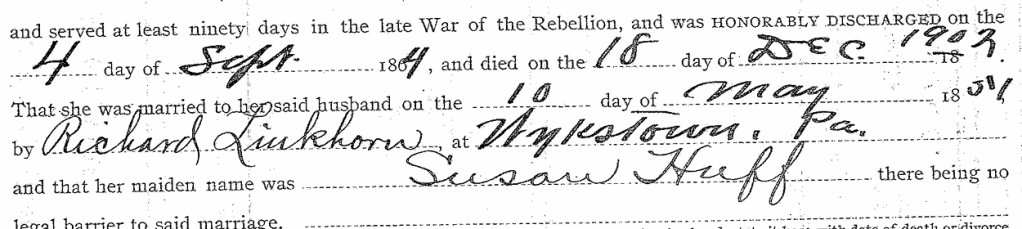
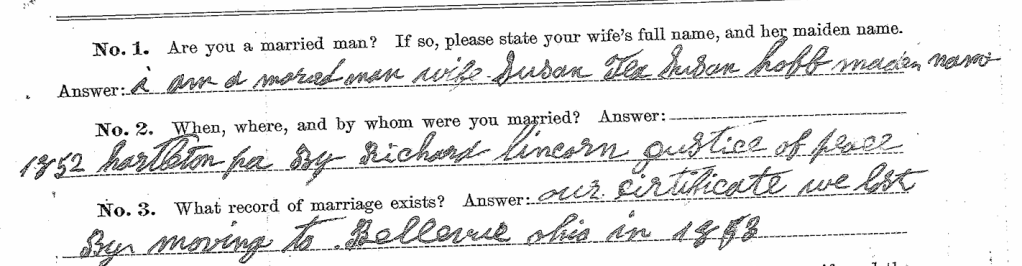
Another section notes they were married in 1852 in Hartleton, PA by justice of the peace, Richard Lincorn. Hartleton is a borough in Union County, PA. This county coincides with the Joseph Huff that is believed to be Susan’s father. On this record it is noted that the family moved to Ohio in 1853 and in the move they lost the marriage record.
In a statement from Susan’s sister Sarah, it notes that Susan and Richard were married in at the home of Eliza Manbeck’s family in a place that was called Centreville in 1904, but went by another name when they married.
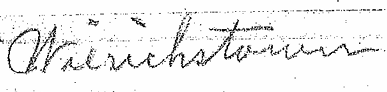
I am still trying to figure out this name and if it was even called that for long. But from what we do know, the marriage did take place in Union County. I found online that Centreville was southwest of Penns Creek in Union County, PA. Near Jack’s Mountain.
Update. While in the middle of writing up this blog post I was doing a page by page review of the 1850 Census record there in Hartley Township (which is where Centreville was in). I ran across someone by the name of Richard Lincoln. I went to Newspapers dot com and looked up Richard Lincoln and Justice of the Peace. And there he is listed as the Justice of the Peace for Hartley for 1851. So we know that his name was not Richard Lincorn or Richard Linkhorn. It was Richard Lincoln. Which kind of makes more sense. It should be noted that a man named Joseph Hartley was a witness to the wedding. He happened to be living with Richard Lincoln in 1850.
Susan may be Emeline from Joseph and Hanna/Joanna Huff’s family. If she wasn’t, she may have been living with other family members at the time of the 1850 Census. There is a chance that she was living with an uncle in Hartley Township in 1850. There is a Susan Huff living with Daniel and Sarah Huff. This reason this is a possibility is mostly because the ages of the children in the house are not in order from oldest to youngest. While Susan was supposed to have been slightly older than this girl, there is still a chance it is her. Regardless of whether this is our Susan in the home of Daniel and Sarah, they are likely her aunt and uncle (or some other relation) so if Emeline is our Susan, then there are many reasons she would be married near aunt and uncle instead of at her parents house.
In the pension record Susan is mentioned as being married at the home of the parents of Eliza Manbeck. Eliza is likely a relation to Susan as her maiden name was likely Huff. So possibly she is a daughter of Daniel and Sarah Huff. There is a chance Eliza is listed more than once in the 1850 Census living with two separate families (maybe even a third location which is not far from the other two) and thus why she wasn’t at home with her parents before her marriage. If Susan Huff got married at the home of Eliza Manbeck’s parents, then they were likely Daniel and Sarah Huff, her likely aunt and uncle.
Until we find a record for Susan and Richard marrying, or find some other evidence of Susan actually being Emeline (or one of the other daughters), we cannot fully confirm that we have her parents. It is still highly probable that Emeline is her and the Susan Huff in Hartley Township is her. I will likely need to contact the archives and other repositories in the area to see if any marriage records with the Justice of the Peace still survive.
The Union County Historical Society is likely going to have the most. https://www.unioncopahistory.com/
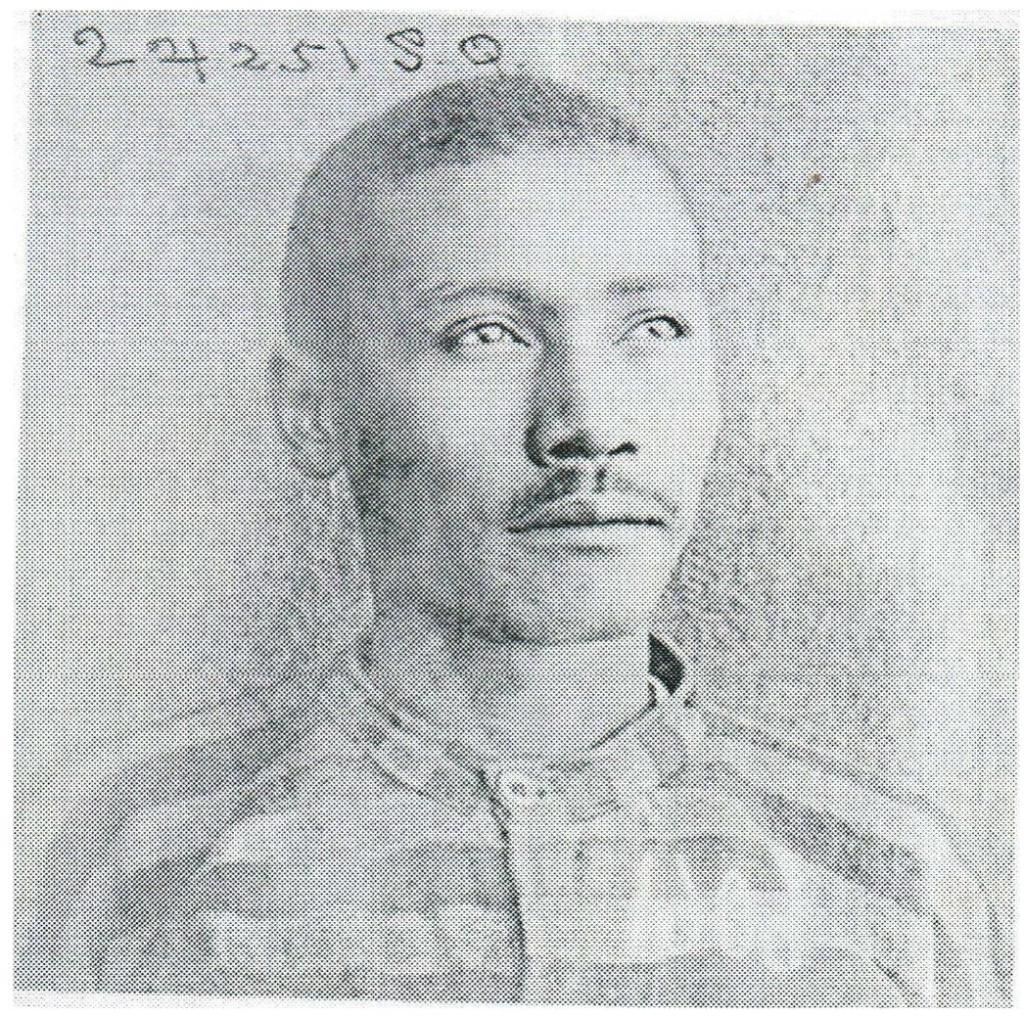
 On Their Shoulders
You must be logged in to post a comment.