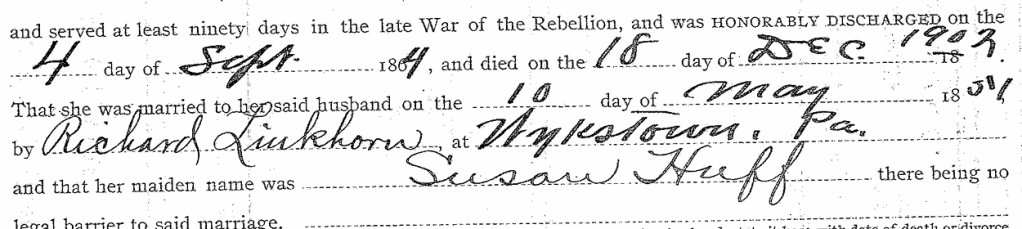
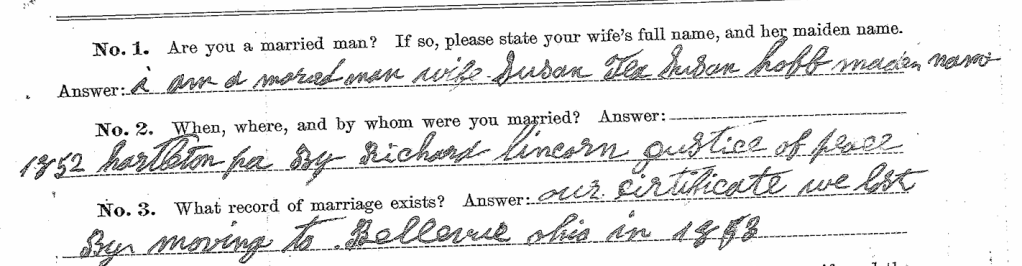
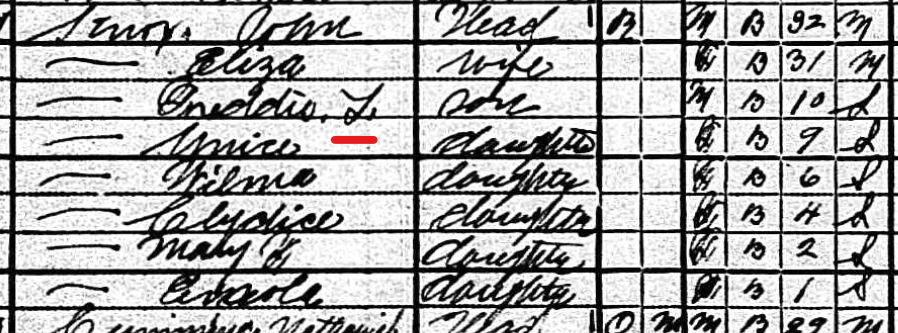
I was chatting with a client about the research I am doing and she mentioned an aunt that was not listed in what I have found so far. I was confused and wondered if it was a bonus aunt like a lot of families have. Nope. Not just a bonus aunt. Definitely her great grandparents biological child. I had worked on that line months ago and got complacent with my research notes. The aunt that I had missed was added to the research notes properly and I began to find more information about her.
This is definitely a reminder to always make sure when making your research notes you note exactly what you see in the document and don’t base it off of transcription done by other people if you can help it. Write out all that you see and compile the information separately.
One way to compare census records over time. These are especially helpful with pre-1850 Census records, but they can also be helpful with census after that as well. There are several spreadsheets that people have made to compare census records. One that I have recently found was shared by Dawn Bingaman over at Ancestor Roundup.
In this document you can list each census record by year and compare ages and other details that might be unclear otherwise. I likely would have seen my error above if I had been using a document like this. It is especially helpful for families with a large amount of children.
It is ok to make mistakes when doing research. The important thing is finding ways to ensure you don’t make the same mistake in the future. And it is great that other researchers have already created tools to make our research easier.
I’ve begun offering genealogy and family history research services. I am excited and also nervous at the same time. I know that I do good research, so that helps me not be as nervous.
Here are some of the things I offer: – general newspaper and other repository searches – family tree work – family group sheets (which cover direct line ancestors and general information on each of their children) -Direct line ancestor mini biographies – local history research
I look forward to supporting you in bringing your ancestor’s lives to life again.
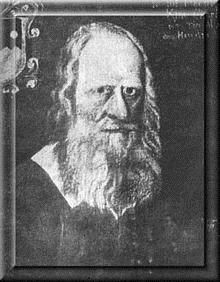
Old black and white copy of a portrait of Lewis Latham. He has piercing eyes, a large nose, a high forehead, and a large beard.
Above is a copy of a portrait of Lewis Latham. He was my 12 times Great Grandfather (14 generations from me). He was a Sergeant Falconer under King Charles I of the United Kingdom. Lewis was born in about 1584 and died a little before May 15, 1655. His daughter Franches Latham (my 11 times great grandmother) is known as “the Mother of Governors”. She is the ancestor to at least ten governors, three deputy/lieutenant governors, and is related by marriage to an an additional six governors and one deputy governor. Frances was baptized in England on February 15, 1609/1610 (so was probably born a few days before the 15th). She died in September of 1677 in Newport, Rhode Island. Genealogy research is easier in some parts of Europe compared to other parts. This is one of only a few of my family lines that goes this far back. If Lewis’s daughter hadn’t had so many notable descendants in North America I have a feeling I never would have learned his name, let alone seen a portrait of him. I am at least thankful that I don’t have any ancestors with the surname Smith. It is one of the most common surnames in English and is also common in a few other languages in Europe. One of my favorite surnames in my tree is Shingledecker. Which surnames are the most common in your country? Which surnames sound the most interesting, unique, or funny to you, no matter the language?
Recently Paul Chiddicks over on bluesky (@chiddickstree) asked how we all got started on our genealogy journey. History has always been a topic that interested me even when I was a small child. I grew up in Grand Rapids, Michigan. Along the shores of the Grand River, just south of the city, are Native American burial mounds (known as the Norton Mounds). There had actually been some in the main part of the city at one point. They were removed, but years later the city decided to recreate them as a memorial to the history. I saw the recreations at some point in my childhood and wanted to learn more. I remember taking out books on Native American history.
In high school I was appointed to the Grand Rapids Historical Commission as a student commissioner. While a student commissioner I was involved in several history events in the city, but most importantly was mentored by Dr. Gordon OIson, city historian, and Jo Ellyn Clarey, another historian. With the help of Jo Ellen I organized a history speaker series during Women’s History Month in my high school that was well attended. I started out a history major in university. It was in my first year of college that I started doing genealogy research on my family. Those early years in online genealogy research were so different than they are today. There were no online repositories like there are today. It was all based on what you could find from other researchers who had done research in archives.
Life took me in another direction for awhile, but after a few journeys around the world I found my way back to genealogy and family history. That was in 2011, not long after my mom died. I got pretty deep in my own family tree, but then realized that I wanted to help others find their ancestors. I’ve volunteered with WikiTree, created a One Place Study on the neighborhood that I grew up in back in Grand Rapids, finding my first paid history research work. I especially like building out people’s Mothers Lines because history has forgotten our mothers so often. My favorite thing I’ve done so far is build out family trees for friends and acquaintances who didn’t know their family history because of the Holocaust and the Transatlantic Slave Trade and it’s aftermath.
The year is almost over, but it’s been an ok year with progress that I’ve made in my research. For 2025 I will be working on spending more time doing my research and not get distracted. My history project plate is completely full, but when I get some of my friends research projects done and the information sent to them then I can start adding more projects, paid ones especially. Consistency will be the word for 2025 (starting now, though 🙂 ).
(Follow me on bluesky at @free2l and my podcast at @theirvoicespod)
I have a lot of trees that I have been working on for friends and have wondered what the best way would be to share my research with them. There are several types of reports that genealogists use that can help share the details of my research with people, but I think the best one for the work I’ve been doing so far is a hybrid of a narrative family history and a general report that includes all the records.
The hybrid nature of the reports I plan on doing bring in important features of the reports I mentioned above.
General Research Report – The reason I am not specifically doing a typical report is because I’m starting out with trees that have several generations that are easily found without needing to write up a detailed report with research questions. There will likely come a time when I work on someone’s tree who has a brick wall they need me to work on, but right now my focus is on sharing the story of the ancestors. What will be included are:
The records that I find for each direct ancestor.
Further research suggestions.
Narrative Family History – The reason I have chosen this as my main focus of my reports is that I plan on including information from secondary sources that fills in the blanks for the family. One example is in a report I have been working on recently. A client’s Dutch ancestor’s WWII military records show his education. It shows he did 7 years at L.O., 3 years at M.M.L.O., and 2 years at an advanced school. Through research I was able to find out details about the Dutch education system in the early 1900s and explain what each of these acronyms meant and explain what their ancestor likely studied. This part of the report would also include a compiled lineage. Emphasis will be put on the direct ancestor of the client unless there are interesting bits of information related to the direct ancestor’s other children. One good part about using a compiled lineage also means that a client can visualize who all the children of their direct ancestors were. I may do more of a family group sheet here instead of a Burke’s Peerage format, but it could be a mix of the two. Each direct ancestor will have a profile specifically about their life. I need to figure out how I will combine the stories of both the husband and the wife together, possibly a chapter on both of their lives.
My very first report is for one of my high school English teachers who is now a friend of mine. I chose her because she is mostly Dutch, like me, but the difference is she is also Jewish. I am learning how to access Amsterdam and North Holland archives and am learning more about the Jewish experience in the Netherlands. Of all the international genealogy research I’ve done I feel most comfortable working with Dutch archives because of all the work I’ve done with my own family. Another reason is that I have the support of an online community of Dutch genealogists. And a few of them have done research on Dutch Jews so that will help me a lot.
While doing some work on the One Place Study I am doing for the neighborhood I grew up in I decided to start looking for when the first non European person moved into the neighborhood. From that I decided to start compiling census records and city directory entries that note a person who is not European. I’m making them available here so that others may be able to find their ancestors easier. So far I have found Black Americans, Chinese Americans, and at least one Native American.
I will be updating this continually. If you happen to find someone not listed on my sheets who should be there, please let me know.
I’ll be following the 52 Ancestors in 52 Weeks prompts this year from Amy Johnson Crow’s website (Find the description and how to sign up to get the prompts HERE). The first prompt is Fresh Start. I’ve chosen my great grandmother Jennie (Shingledecker) Mohney to write about for fresh start.
Jennie was born in 1890 in Schoolcraft, Michigan. Her parents were William and Nettie Mae Shingledecker. She was the 2nd child of four. She married John Ray Mohney when she was 18 years old. They had their first child before the end of that year. By the 1920 Census the family had moved to South Dakota and included 4 more children. Jennie was still in South Dakota during the South Dakota state census of 1925 and she had 3 more children by that date.
Things were not going great in the family as her husband had taken on a mistress. He had two children with the woman while still living with Jennie. Things must have come to light sometime in 1925 or early 1926 because Jennie was back in Michigan with the birth of her youngest daughter, Beatrice (my grandmother).
From her son Carl’s obituary I found out that John Ray actually moved the family back to Michigan, but then ended up leaving the family (to go back to his mistress). It must have been difficult to lose her husband that way. One way that she made it work was to tell people that her husband had died. All records I’ve found so far show Jennie as a widow. These include census records from 1930 and 1940 as well as marriage records for her children.
Jennie wasn’t alone in handling this fresh start. Her older children definitely helped out. Not only did she have her oldest daughters to help out, it seems she fostered a spirit of working hard in her children. In her son Carl’s obituary it notes that he taught his children “”The Mohney Way”: value hard work and do things right the first time.” I imagine that was more something he learned from his mother, Jennie, as she was the one who raised Carl alone for most of his childhood. While I get calling it the Mohney Way because his last name was Mohney, but I would have called it the Shingledecker Way, as his mom was the one who taught him hard work and sticking with those who matter most.
I don’t know much about her life overall, but I know Jennie was a hard worker. She raised 9 children who all grew to be hard working adults. She spent her later years with her children’s families, including visiting her daughter May’s family home in Charlevoix, Michigan.
Jennie (Shingledecker) Mohney was a hard working woman who raised 9 children. I am grateful for her determination to care for her children even through the heartache of losing her husband the way she did. I’m glad my grandmother had such a strong woman role model in her life because she ended up making a good impression on my mother who made a good impression on me. I am forever grateful for her. She truly made the most of her fresh start away from her husband.
I’ve been to two naturalization ceremonies and at each one the new citizens take the oath of allegiance. All the new citizens stand and repeat the oath after the presiding judge. It is an uplifting experience. Interesting fact, the first citizens of the United States (free men to be specific) were required to take an oath of allegiance as well.
I found that one of my ancestors (Richard Tea) was appointed as a commissioner to administer the oath/affirmation of allegiance. There seem to be different versions of the oath that I’ve found. And I believe each state had their own version of the oath, though they would all have been similar. The Wikipedia article on the current oath of allegiance says that parts of it were based on the British Oath of Supremacy, written in the 16th century (though the article does not cite a source on this statement).
There were several versions of the oath. There was even one that officers in the Continental Army took. Here is one form of the oath as printed in The Pennsylvania Packet (Philadelphia, Pennsylvania) from Tuesday February 2, 1779.
I’ve tried to find Richard Tea’s name in the many lists of those who took the oath of allegiance, but possibly there’s a reason he’s not included in it. If he name is listed as someone who could administer the oath, he had to have taken the oath.
“I don’t think you can ever leave home.
You take it with you. It’s in your hair follicles,
in the bend of your knees, the arch of your foot.
You can’t leave home. You just take it and rearrange it”
– Maya Angelou, African-American Lives (PBS), 2007
Welcome to my family history blog. Come join me as I learn more about both sides of my family. The four most recent family names are Jousma, Clark, Julien, and Mohney. I will be sharing personal data on my ancestors as well as information on the places they lived and events that they may have lived through.
Beecher Family
Bensinger Family
Clark Family
Clawson Family
Coffey Family
Henderson Family Jouwsma/Jousma Family – Fryslan (Friesland) Netherlands
Julien Family
Moerland Family – Zeeland, Netherlands
Mohney Family
Moyer Family
Neele Family – Zeeland, Netherlands
Robinson Family
Shingledecker Family – Southwest Germany
Tea Family
You must be logged in to post a comment.